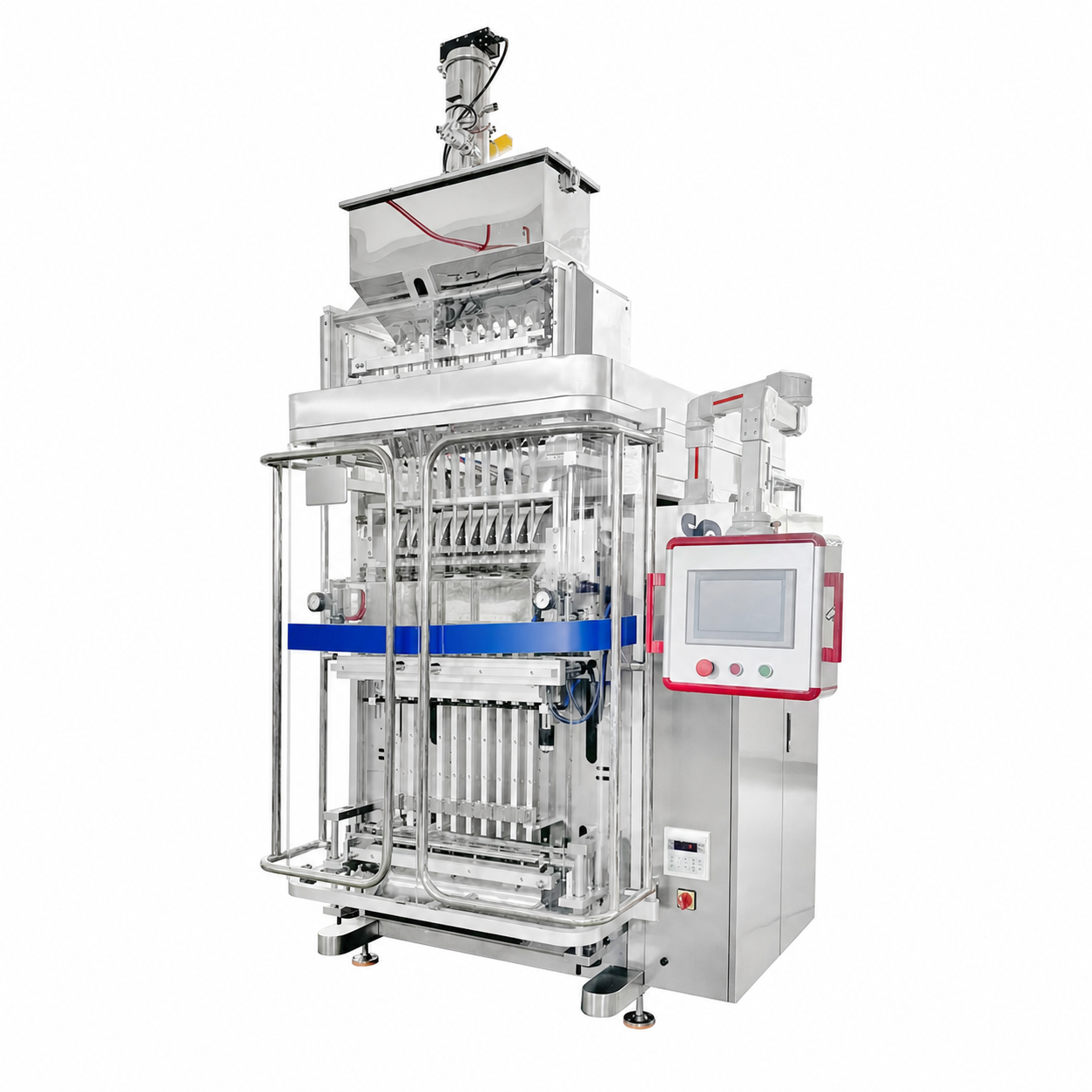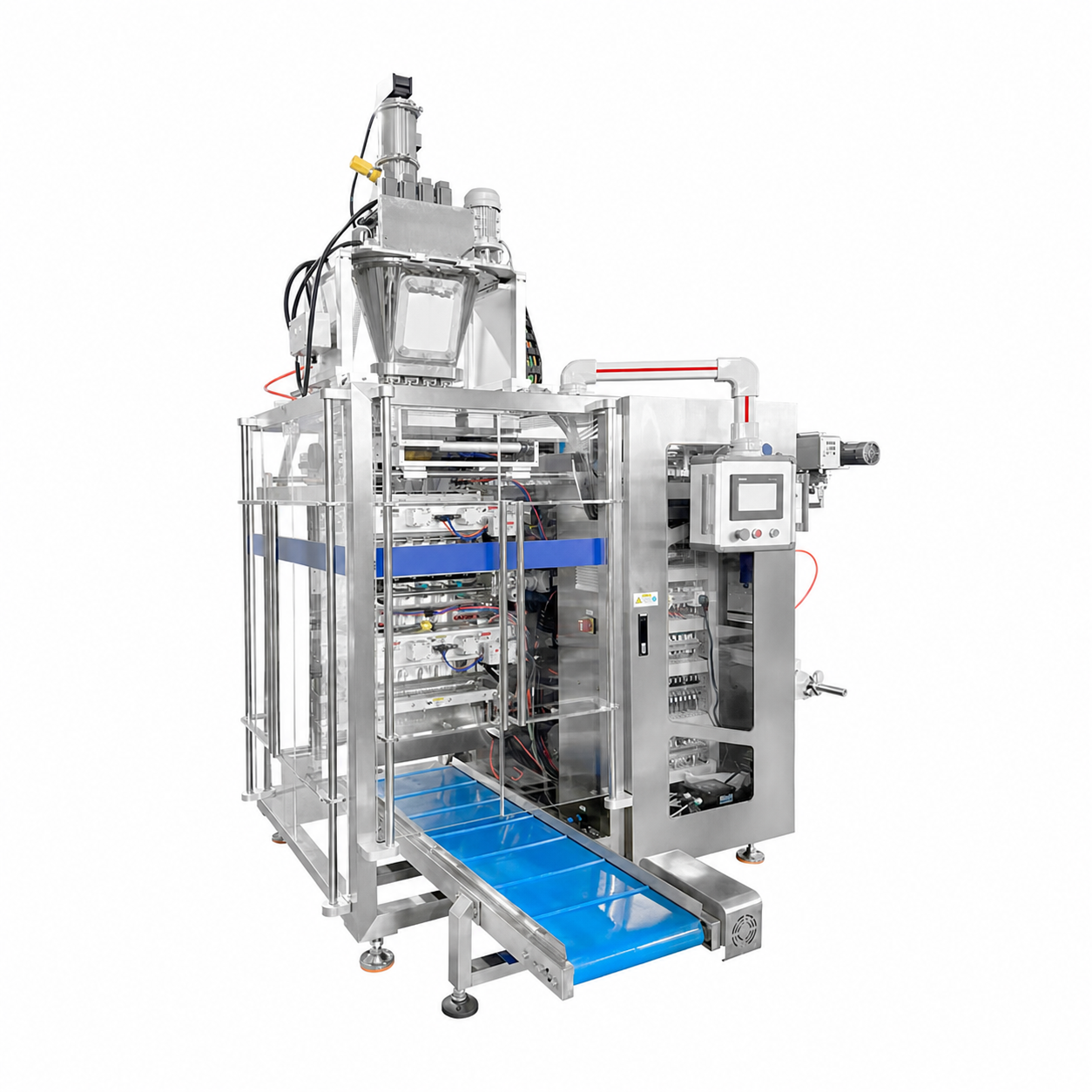
Portioned liquids and semi-liquids in narrow packs.
The format is useful for products requiring controlled doses and high printed-pack output.
Multi-lane liquid packaging
A pump-fed format for portioned food, cosmetic, household and selected pharmaceutical liquids—configured around viscosity, compatibility, temperature and cleaning method.
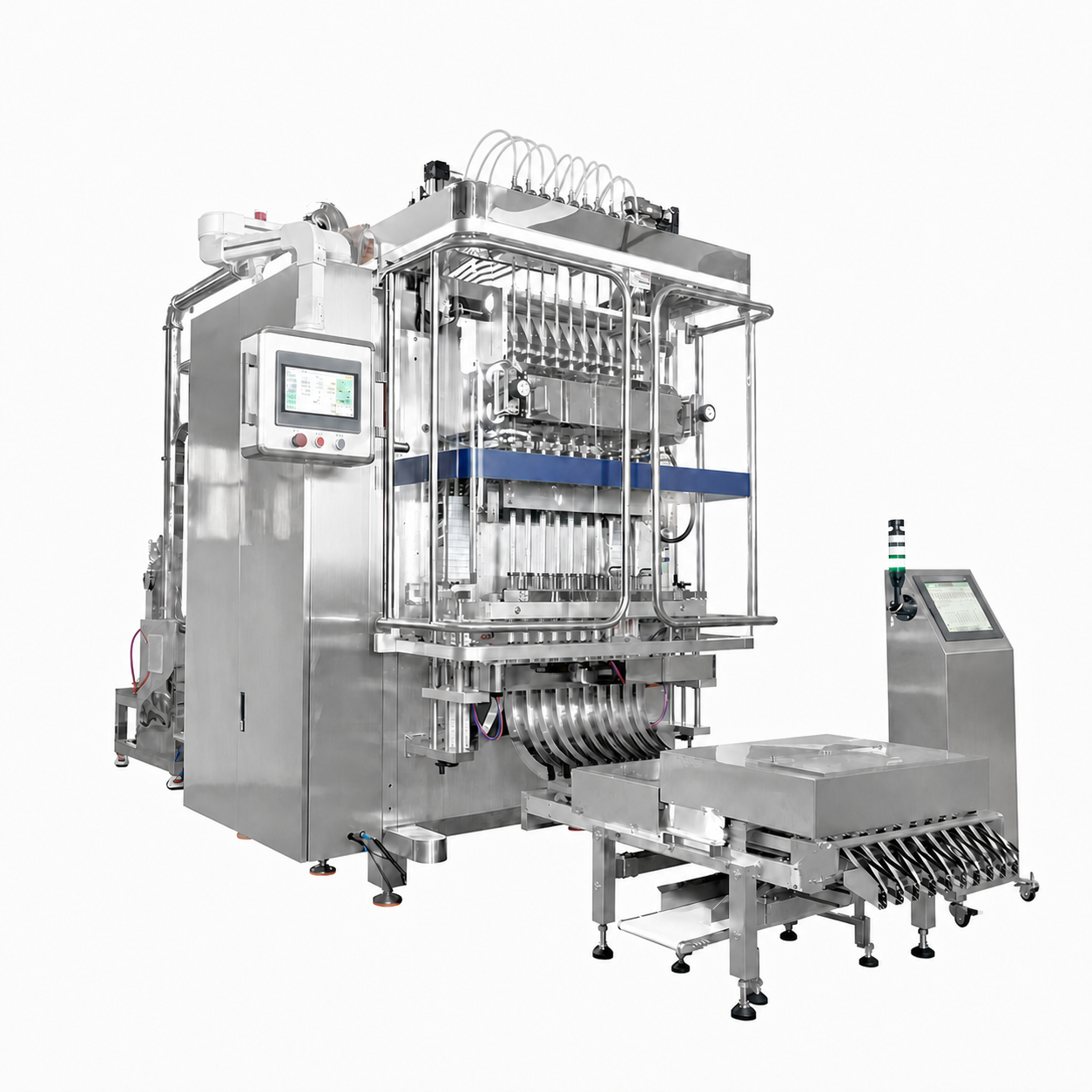
01 / Application fit
Viscosity alone is not enough. Product particles, foaming, stringing, temperature sensitivity and sanitation requirements all influence the filling circuit.
The format is useful for products requiring controlled doses and high printed-pack output.
Large inclusions, rapid settling, foaming or aggressive sanitation can change the pump, valve, hose, hopper and CIP scope. Provide the actual recipe and operating temperature.
02 / Operating principle
The filling path must deposit a repeatable dose while keeping the film’s sealing area clean.
The hopper and liquid circuit maintain the required feed, temperature or agitation.
Piston, ceramic or peristaltic pumping is screened against viscosity and hygiene.
The film is formed into lanes and the product is delivered with controlled timing.
Heat and pressure make the final seals before straight, zigzag or round cutting.
03 / Key capabilities
The selection should consider product recovery, changeover, cleanability and seal integrity—not only nominal output.
Reference choices include piston, ceramic and peristaltic pumps.
Parallel lanes increase output for suitable low-dose products.
Servo pulling and registration controls support repeatable printed packs.
Independent control supports consistent sealing across the machine width.
Product-contact materials, circuit access and cleaning provisions are defined around compatibility and regulatory needs.
Counting, collating, cartoning and case packing can extend the line.
04 / Reference specification
The stated values screen the machine family; they do not replace a pump trial with the real liquid.
| Reference capacity | 30–45 cycles/min |
|---|---|
| Stick bag length | Maximum 300 mm |
| Stick bag width | Maximum 70 mm |
| Filling method | Piston pump / ceramic pump / peristaltic pump |
| Reference filling range | 1–100 ml |
| Film | Composite film / aluminium film |
| Cutting | Straight / zigzag / round |
| Lane reference | Typically multi-lane; final count depends on pack and output |
| Frame reference | SS304 |
| Control reference | PLC, touchscreen, servo film pulling and colour-mark control |
| Seal control | Independent temperature control |
05 / Configurable scope
The pump is only one component between product preparation and a clean finished pack.
Stabilise what reaches the filler.
Match contact parts and metering action.
Set the practical sanitation boundary.
Connect finished sticks to the required sales unit.
06 / Selection brief
Give the engineering team enough information to screen the pump, seals and sanitation plan.
Start my configuration ↗Viscosity at filling temperature, particles, foaming, stringing and settling.
Nominal volume or weight, density and allowable deviation.
pH, temperature, ingredients, chemical behaviour and contact-material requirements.
Frequency, detergent, water temperature, CIP expectation and changeover time.
Film structure, bag drawing, target cycles, lane output and secondary packing.
Related systems
Dry products change both the metering unit and the hygiene risks.
Send the recipe behaviour, filling temperature, dose and pack drawing for an initial review.