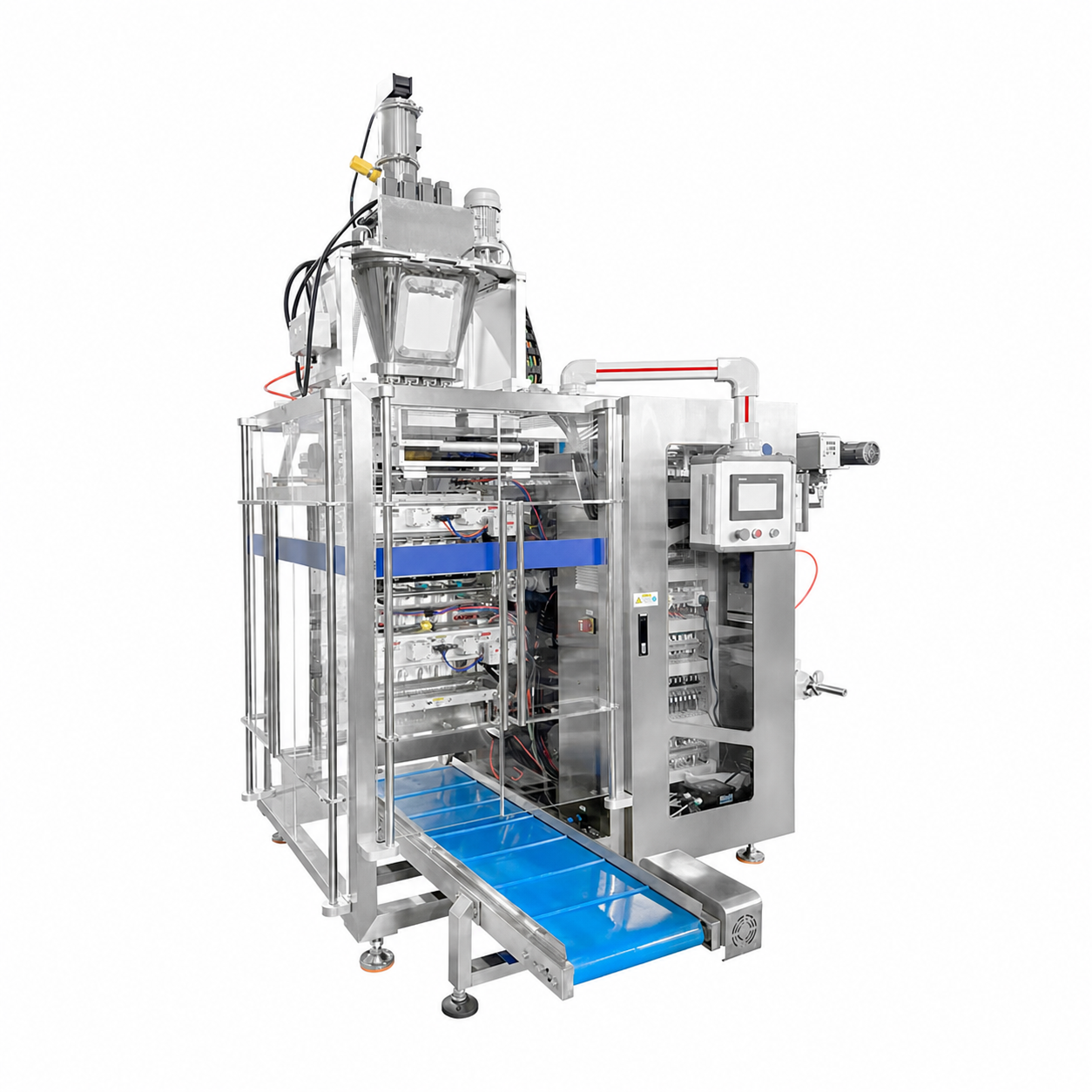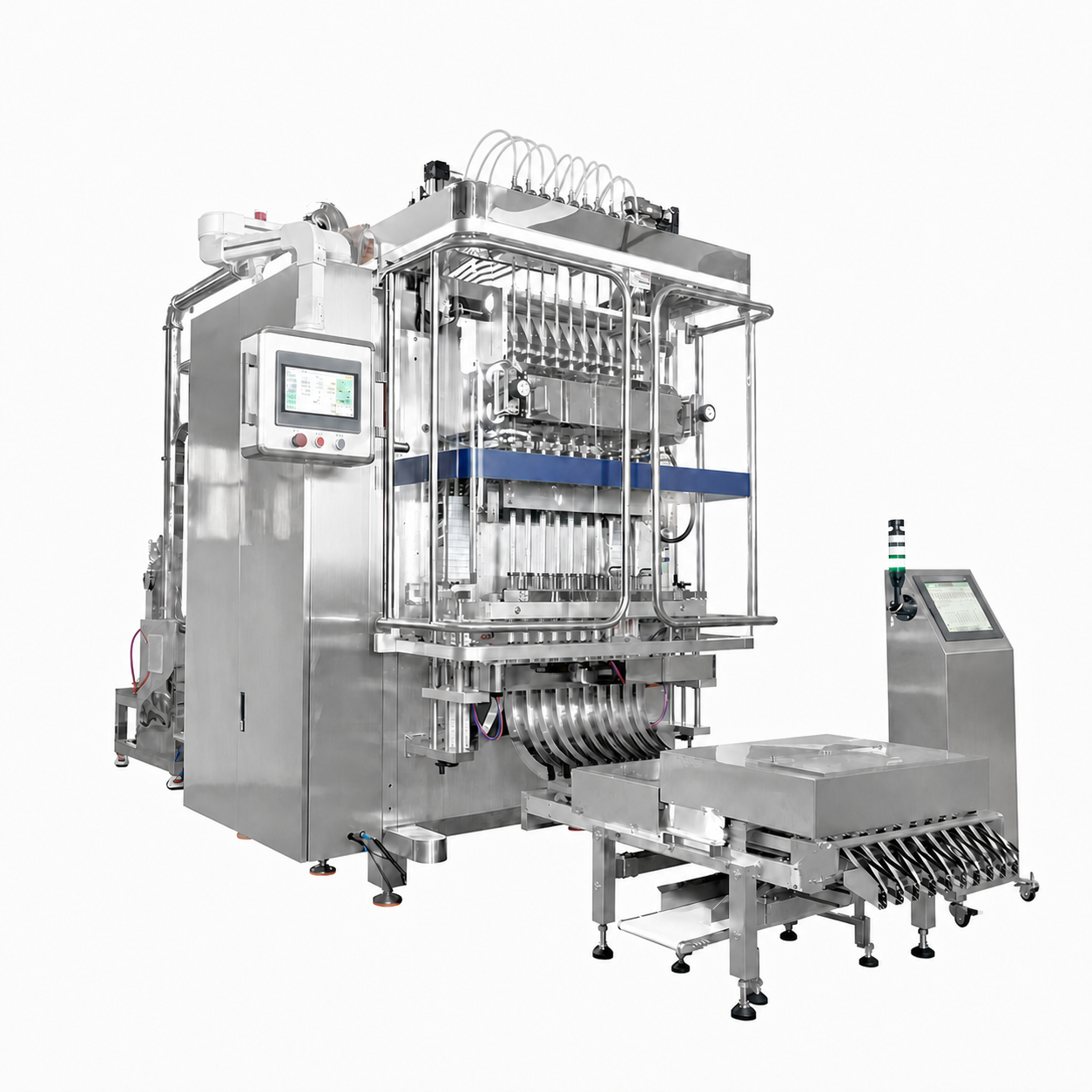
Small measured doses produced at scale.
Use it when narrow back-seal packs, high lane count and compact secondary packing are central to the project.
Multi-lane primary packaging
A compact, high-output format for measured doses of free-flowing food ingredients, pharmaceutical granules and other stable particles.
01 / Application fit
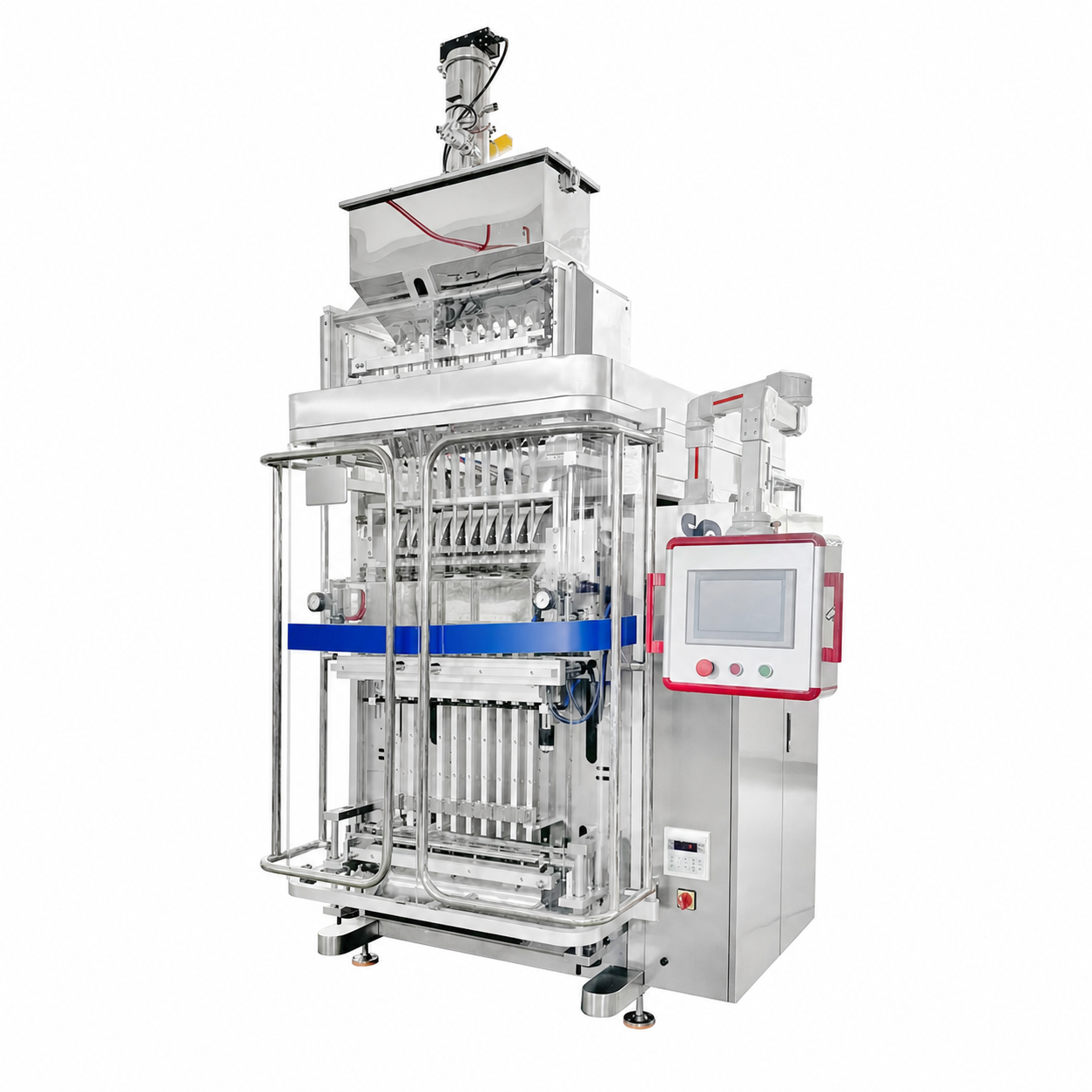
The volumetric-cup architecture is strongest when granules feed repeatably and do not bridge, clump or generate excessive dust. A sample test confirms whether the nominal range is realistic.
Use it when narrow back-seal packs, high lane count and compact secondary packing are central to the project.
Sticky, oily, fragile or poorly flowing material may need a different feeder. The supplier lists 1–30 g as a reference range, while achievable accuracy and speed depend on the product and target dose.
02 / Operating principle
Each lane performs the same sequence in parallel, converting controlled product flow into individually sealed doses.
A volumetric cup system portions free-flowing granules before discharge.
The web is guided into multiple narrow tubes with controlled registration.
Product enters each formed stick before longitudinal and cross seals close the pack.
Finished sticks are cut, counted or transferred to downstream packing.
03 / What the configuration controls
Film handling, dosing, sealing and downstream organisation must be specified together.
Four to twelve lanes allow the platform to scale from medium to high output.
A repeatable approach for free-flowing particles when bulk density is stable.
Controlled film pulling supports registration and consistent finished length.
Reference compatibility includes laminated and aluminium film for moisture-sensitive products.
Reference configuration includes PLC and multi-language operator interface.
Counting, ordered arrangement, cartoning and end-of-line handling can be scoped together.
04 / Reference specification
Use these figures to screen feasibility, not as the final commercial specification.
| Lane range | 4–12 lanes |
|---|---|
| Pack type | Stick pack, back seal |
| Product type | Granules / free-flowing powder |
| Reference filling range | 1–30 g |
| Reference speed | 30–45 bags/min/lane |
| Reference total output | Up to 500 bags/min |
| Bag width | 20–40 mm |
| Bag length | 50–160 mm |
| Film | Aluminium / laminated film |
| Product-contact / frame reference | SS304; SS316 subject to configuration |
| Control reference | PLC with servo film pulling |
| Electrical reference | 3-phase 380 V, 50/60 Hz |
05 / Configurable scope
The useful line boundary depends on how finished sticks must be inspected, grouped and shipped.
Choose the details customers touch and quality teams inspect.
Add controls appropriate to the product risk and customer standard.
Keep product flow and the machine environment controlled.
Turn loose sticks into a retail or logistics unit.
06 / Selection brief
The first review should establish whether the product can be dosed cleanly and repeatedly.
Start my configuration ↗Include particle size, flowability, moisture and any tendency to bridge or break.
State nominal weight, allowable deviation and verification method.
Bag width, length, film structure, artwork repeat and tear feature.
Good packs per minute, shifts and expected product changeovers.
Loose discharge, counting, cartoning, case packing or palletising.
Related systems
The correct filler changes when granules become dusty powders or viscous liquids.
Send a sample description, target dose and pack drawing. We will identify the next validation step.